
- Industry News
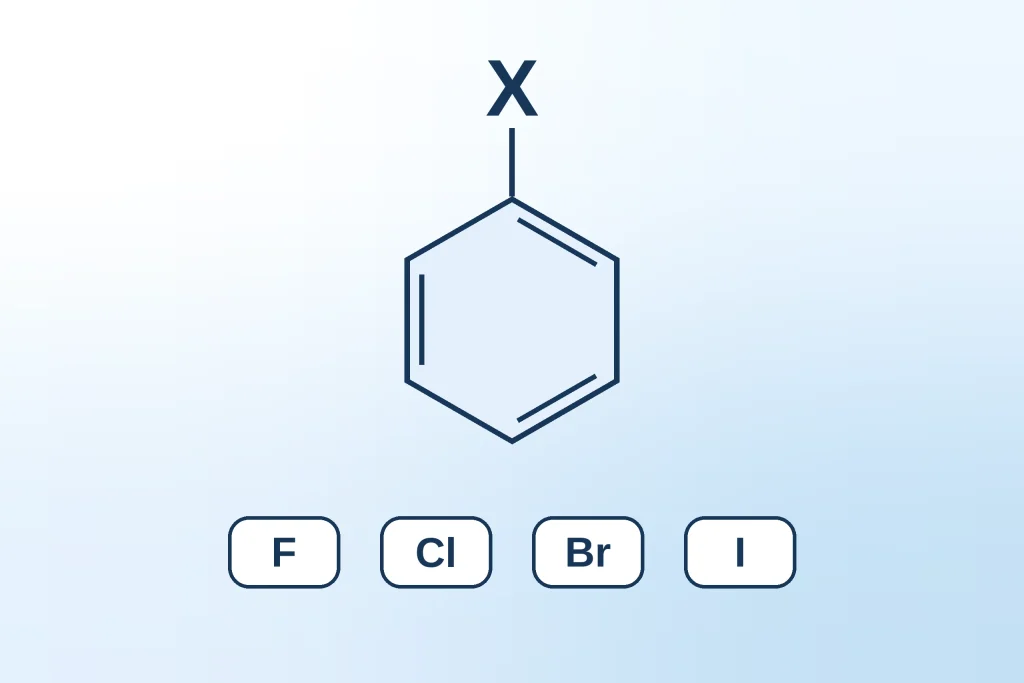
Aryl halides are among the most widely used halogenated aromatic compounds in chemistry today. Whether you’re building a drug molecule from scratch or setting up a cross-coupling reaction, these aryl halide building blocks show up at nearly every step. They’re versatile, well-studied, and available across a broad range of structures..

- Industry News
The rise of GLP-1 peptide drugs like semaglutide and tirzepatide has pushed peptide manufacturing into overdrive. Every gram of these molecules is built one amide bond at a time, and none of those bonds form on their own. A carboxylic acid and an amine sitting next to each other at..
- Industry News
Antibody-drug conjugates get called biological missiles for a reason. The antibody finds the tumor cell, the payload kills it, and sitting between them is a small chemical structure that most people never think about until it fails. That structure is the ADC linker, and it decides whether the drug works..

- Industry News
Drug development costs keep climbing, and fewer companies want to build their own manufacturing plants from scratch. Outsourcing has become the default path, not the exception. But once you start talking to vendors, two acronyms show up everywhere: CMO and CDMO. They sound similar, and some sales reps use them..

- Industry News
Two enantiomers of the same molecule share almost every physical property. They boil at the same temperature. They melt at the same point. They dissolve the same way in the same solvent. A standard distillation column cannot tell them apart, and neither can ordinary chromatography. So how does the pharmaceutical..

- Industry News
In 2018, regulators pulled valsartan tablets off shelves worldwide after finding trace amounts of a chemical called NDMA inside the active ingredient. Ranitidine and metformin followed a similar path over the next two years. The common thread was a class of compounds known as nitrosamines, and the fallout changed how..

- Industry News
Most drug molecules on the market today carry at least one stereocenter, and the atom that becomes that stereocenter usually starts out flat, symmetric, and achiral. Chemists call this starting point prochiral. It’s not a chiral molecule yet, but it’s one reaction away from becoming one. This idea sits at..

- Industry News
API manufacturers spend years developing a synthesis route. That route contains process steps, impurity controls, and material specifications that competitors would love to copy. At the same time, the FDA needs to see all of that detail before it lets a drug reach patients. These two needs pull in opposite..

- Industry News
You spend weeks purifying a compound to 99% ee, and if storage conditions are wrong, that single enantiomer slides back toward a 50:50 mixture within days. That process is racemization, the conversion of an optically active compound into a racemic mixture, along with the loss of optical activity. The molecule..

- Industry News
Two molecules can share the exact same chemical formula and the exact same atom-to-atom connections, yet behave completely differently in the body. The only difference between them is a mirror-image arrangement in 3D space. This is optical isomerism, and it’s one of the more surprising ideas in organic chemistry once..

- Industry News
Peptide drugs are having a moment. GLP-1 medicines like semaglutide and tirzepatide have turned peptide manufacturing into one of the busiest corners of the pharmaceutical industry. Behind almost all of that production sits one core method: solid phase peptide synthesis, or SPPS. The technique was developed by Robert Bruce Merrifield..

- Industry News
In chiral chemistry, making a molecule with the right handedness is only half the job. What actually matters is how much of the wrong handed version is mixed in. Enantiomeric excess, usually written as ee, is the number chemists use to describe that purity. It tells you how far a..

- Industry News
What Is a Stereocenter A stereocenter (also called a stereogenic center) is any atom in a molecule where swapping two attached groups produces a different stereoisomer. That’s the whole definition. It doesn’t say anything about mirror images or optical activity — it just says the swap changes the molecule’s 3D..

- Industry News
Large scale organic synthesis is the discipline of producing organic compounds in substantial quantities—ranging from kilograms to metric tons—while maintaining consistent quality, safety, and cost efficiency. Unlike laboratory-scale reactions that focus on proof-of-concept, large scale synthesis bridges the gap between discovery chemistry and commercial manufacturing. This process is central to..

- Industry News
Commercial scale-up manufacturing is the strategic and engineering-intensive process of transforming a validated laboratory or pilot-scale chemical synthesis into a repeatable, cost-effective, and compliant full-scale production operation. For pharmaceutical, fine chemical, and specialty material companies, mastering this transition is often the single most important factor determining whether a promising molecule..

- Industry News
Pilot plant scale-up services form the essential bridge between laboratory-scale chemistry and full commercial production. When a chemical process demonstrates success at the bench, it must be tested and refined at an intermediate scale before committing to expensive, large-volume manufacturing. The pilot plant stage validates that a process is safe,..

- Industry News
Custom scale-up manufacturing is the specialized process of transitioning a chemical synthesis from small laboratory quantities to larger, commercially viable production volumes—without compromising quality, purity, or consistency. For pharmaceutical, agrochemical, and specialty chemical companies, mastering scale-up is the critical bridge between a promising discovery and a market-ready product. What Is..

- Industry News
Boronic acids have become indispensable building blocks in modern chemistry, powering everything from pharmaceutical breakthroughs to advanced material development. As demand for these specialized organoboron compounds continues to accelerate, boronic acid custom production has emerged as a critical service for research organizations, pharmaceutical developers, and material scientists who require tailored..
- Industry News
Chirality plays a decisive role in the safety, efficacy, and performance of modern pharmaceuticals, agrochemicals, and specialty materials. Custom chiral synthesis services deliver enantiomerically pure compounds tailored to exact specifications, enabling researchers and manufacturers to develop single-enantiomer products with confidence. As regulatory agencies increasingly require detailed stereochemical characterization, partnering with..

- Industry News
The industrial production of novel compounds represents one of the most critical and complex stages in the chemical and pharmaceutical value chain. Transforming a newly discovered molecule from a laboratory-scale curiosity into a commercially viable, mass-produced substance requires a sophisticated blend of chemistry, engineering, quality assurance, and regulatory expertise. As..